
How to Explain Employment Gaps on Your Resume
Gaps happen. Here's how to handle them without torpedoing your chances.
You've got a hole in your work history. Maybe it's a few months. Maybe it's a few years. Maybe you were laid off, locked up, taking care of someone, dealing with your own health, or just couldn't find work no matter how hard you tried.
Whatever the reason, you're staring at that gap on your resume wondering if it's going to sink you.
Here's the reality: Nearly two-thirds of workers have taken some kind of career break. You're not the exception -- you're the norm. The question isn't whether you have a gap. It's whether you know how to frame it.
I've spent over a decade writing resumes for people with gaps of every kind. This guide is everything I've learned about how to handle them.
What Employers Actually Think About Gaps
Let's cut through the noise and look at the data.
The Good News
A 2023 LinkedIn survey found 79% of hiring managers would still hire applicants with career gaps. A 2025 MyPerfectResume survey of 918 HR professionals reported 95% are more understanding of employment gaps than they used to be, with 44% saying gaps are expected and not viewed negatively.
Post-COVID, gaps are everywhere. Employers know this.
The Bad News
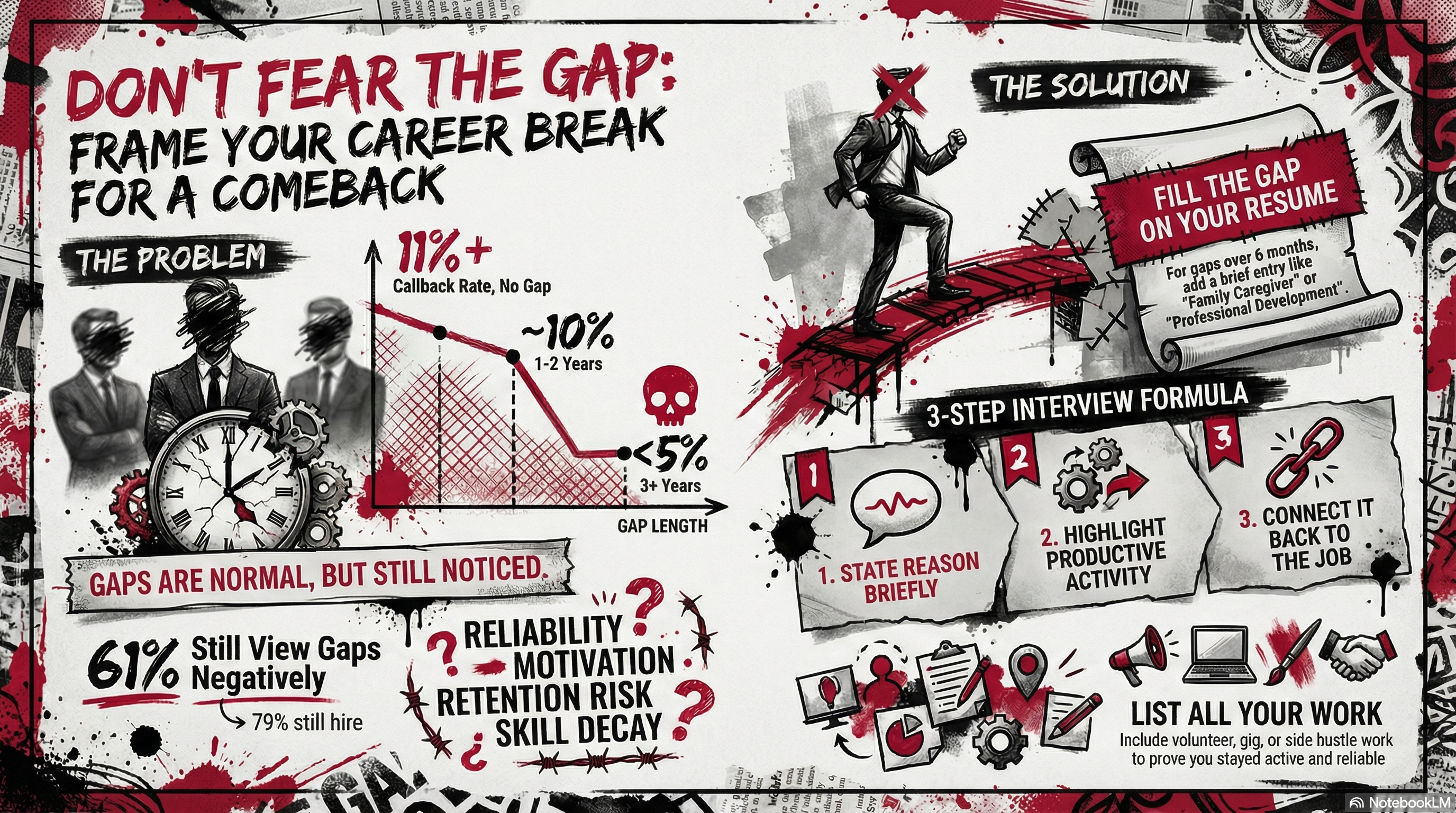
That same research shows 61% of hiring managers still consider resume gaps a negative sign. They're more understanding -- but they're still noticing.
And the numbers get worse as gaps get longer. Harvard Business Review research from 2024 tracked actual callback rates:
| Gap Length | Callback Rate |
|---|---|
| No gap | 11%+ |
| 1-2 years | ~10% |
| 3 years | 4.6% |
| 4 years | 3.7% |
| 5 years | 3.1% |
Translation: A gap of a year or two barely hurts you. But once you hit three years or more, your chances drop by more than half.
What Employers Are Actually Worried About
When hiring managers see a gap, here's what's running through their heads:
- Reliability (29%) -- "Will they show up? Will they stick around?"
- Motivation (27%) -- "Do they actually want to work?"
- Retention risk (25%) -- "Are they going to leave in six months?"
- Skill decay (19%) -- "Are their skills still current?"
Notice what's NOT on that list: judgment about your character, assumptions about what happened, or automatic disqualification. They're not thinking "this person is broken." They're thinking "is this person going to be a good employee?"
Your job is to answer those concerns before they become objections. That's exactly what I help people do every day.
The Gap Threshold: When Does It Actually Matter?
Not all gaps are created equal. I tell clients to think about this in tiers.
Gaps Under 6 Months
Most employers won't even blink. In 2024, the median unemployment spell was 9.6 weeks -- over two months. A few months between jobs is completely normal, especially in today's market where layoffs happen fast and hiring moves slow.
What to do: Nothing special. Keep your dates accurate. Focus on your skills and experience. Don't draw attention to something that doesn't need attention.
Gaps of 6 Months to 2 Years
This is where employers start noticing, but it's still manageable. The callback rate only drops slightly for gaps in this range.
What to do: Have a clear, brief explanation ready. Consider adding a line on your resume if you did something productive during the gap (more on this below).
Gaps of 3+ Years
This is where it gets harder. Callback rates drop dramatically -- from 11% to under 5%. Employers start wondering if your skills are current and whether you're truly ready to return to work.
What to do: You'll need to actively address this gap. Show what you did during the time, demonstrate current skills, and be prepared to discuss it directly in interviews. I've helped plenty of people overcome gaps this long -- it takes more strategy, but it's absolutely doable.
Common Gap Reasons: The Good, The Understandable, and The Tricky
Reasons Employers Generally Accept
Layoffs or company closure -- Not your fault. Most employers get it, especially post-2020. Just state it simply: "Position eliminated due to restructuring."
Caregiving -- Taking care of kids, aging parents, or a sick family member. This is increasingly normalized. About 51% of HR professionals say the reason for a gap matters, and caregiving is near the top of acceptable reasons.
Health or medical leave -- You don't owe anyone details. "Medical leave" or "health-related leave" is sufficient. If you're recovered and ready to work, that's what matters.
Education or retraining -- Went back to school? Got certifications? This is actually a positive -- you invested in yourself.
Pandemic disruption -- COVID reshuffled everything. Employers lived through it too.
Reasons That Require More Care
Couldn't find work -- This happens, but framing matters. "Extended job search" sounds passive. Better: highlight what you did during that time (freelance, volunteer, courses, etc.).
Fired from previous job -- Don't lie, but don't volunteer it either. If asked, keep it brief and forward-looking.
Incarceration -- This intersects with criminal record disclosure. The gap itself isn't the issue -- the record is. (See my guide: How to Write a Resume with a Felony)
Exploitation or trafficking -- Some gaps come from situations you didn't choose. You don't owe anyone the details -- you owe them proof you're ready now. I've worked with clients who lost years to circumstances that were done to them, not by them. On the resume, this is simply a "career break" or "personal circumstances." In the interview, you share only what you're comfortable sharing, and you pivot hard to what you've done since. Nobody is entitled to the whole story. They're entitled to know you'll show up and do the work.
The Worst Approach
Long unexplained gaps with no context. This is what triggers all the employer concerns at once. It looks like you're hiding something, which makes them assume the worst.
Even if the truth is hard to talk about -- you don't have to give them the full story. But you need to say something that shows you weren't just standing still. The bar here is lower than people think. Any evidence of forward motion counts.
Resume Strategy: How to Handle Gaps on Paper
Format Choices
Chronological (Standard): Lists jobs in reverse order with dates. This is what most employers expect and what ATS systems parse best. I recommend this as your default.
Hybrid/Combination: Leads with a skills summary, then lists work history. This shifts focus from dates to capabilities without hiding your timeline. Good for gaps of 1-2 years.
Functional (Skills-Only): Groups experience by skill area with minimal dates. Avoid this. Hiring managers and ATS systems see it as a red flag that you're hiding something. It almost always backfires. I've tested this enough to know.
The Years-Only Trick
Instead of listing "March 2021 - November 2022," you can list "2021 - 2022." This makes short gaps less visible.
Caution: Don't use this to hide multi-year gaps or to be deceptive. It's a formatting choice, not a lying strategy. If someone asks for exact dates, give them.
Filling the Gap on Your Resume
For gaps over 6 months, consider adding an entry that shows what you were doing. Keep it professional and brief:
Caregiving:
Family Caregiver | 2022 - 2023
Managed full-time care responsibilities for family member. Maintained professional skills through online coursework in [relevant topic].
Education:
Professional Development | 2021 - 2022
Completed [certification name]. Coursework in [relevant skills].
Job Search + Side Work:
Freelance / Contract Work | 2022 - 2023
Provided [type of service] for local clients while pursuing full-time opportunities. Completed [number] projects.
Health-Related or Personal Circumstances:
Career Break | 2021 - 2022
Personal leave. Returned to workforce ready to contribute.
You don't need to over-explain. You just need to show the time wasn't empty. I've written hundreds of these entries, and the key is always the same: short, dignified, forward-looking.
What About Volunteer Work, Gig Work, or Side Hustles?
List them. Seriously.
Drove for DoorDash? That's logistics and customer service. Did odd jobs on TaskRabbit? That's problem-solving and reliability. Volunteered at a food bank? That's showing up and doing work.
Employers worry about skill decay and work ethic. Showing that you stayed active -- even in unpaid or informal work -- directly counters those concerns.
Cover Letter: Address It or Wait?
For major gaps (2+ years): Address it briefly in the cover letter. One sentence. Then pivot immediately to your qualifications.
"After taking time to care for a family member, I'm ready to return to the workforce and bring my [X years] of [industry] experience to your team."
For shorter gaps: Don't bring it up. You're just drawing attention to something that might not even register. Let them ask if they want to know.
The rule: If the gap is big enough that they'll definitely notice and wonder, get ahead of it. If it's borderline, don't create a problem that doesn't exist yet. I tell clients: if you'd notice it scanning your own resume, address it. If you wouldn't, leave it alone.
Interview Scripts: What to Say When They Ask
At some point, you'll hear: "I see there's a gap here. Can you tell me about that?"
Here's the framework I coach every client on:
The 3-Step Response
- State the reason briefly and neutrally (5 seconds)
- Highlight what you did during the gap (10 seconds)
- Connect back to this job (10 seconds)
Example Scripts
Layoff:
"My position was eliminated when the company restructured in 2022. During that time, I completed my [certification] and did some freelance work to keep my skills sharp. I'm excited about this role because [specific reason]."
Caregiving:
"I took time off to care for a family member who needed full-time support. During that period, I stayed current with industry developments and completed some online training. Now that my situation has changed, I'm fully ready to commit to a full-time role."
Health:
"I took a medical leave to address a health issue. I've fully recovered and I'm ready to get back to work. During my time off, I [stayed active through X] and I'm eager to apply my experience here."
Couldn't find work:
"The job market was tough in my area for [industry] roles. While searching, I did [freelance/volunteer/gig work] to stay productive. I'm glad to have found this opportunity because [reason]."
Incarceration (if directly asked):
"I was incarcerated for [general category] in [year]. Since then, I've [specific rehabilitation -- programs, certifications, work experience]. I'm focused on building a stable career, and I'm prepared to be the hardest-working person on your team."
Difficult personal circumstances (exploitation, trafficking, or situations beyond your control):
"I went through a difficult personal situation that's been fully resolved. Since then, I've [specific actions -- training, employment, volunteer work]. I'm in a stable place now and I'm focused on building a career I can be proud of."
You don't owe anyone the details of what happened to you. You owe them confidence that you're ready now.
What NOT to Do
- Don't over-explain. The longer you talk, the more you sound defensive.
- Don't get emotional. Keep it matter-of-fact.
- Don't blame others. Not your ex-employer, not the economy, not anyone.
- Don't leave it unexplained. Silence is worse than any reasonable explanation.
- Don't contradict what a background check will show. If you were incarcerated, don't pretend you were "traveling."
Legal Reality: Can They Reject You for a Gap?
Short answer: Yes, usually.
There's no law that says employers can't consider employment gaps. They can decide a gap makes you less qualified, and that's legal.
However, they can't use gaps as a cover for discrimination:
- Disability-related gaps: If your gap was due to a disability and they know it, rejecting you "because of the gap" could violate the ADA.
- FMLA-protected leave: If you took legal medical or family leave and were penalized for it, that's potentially illegal.
- Caregiver discrimination: While "caregiver" isn't a protected class federally, the ADA protects against discrimination based on association with someone who has a disability.
If you suspect you were rejected because of a protected reason disguised as "concern about your gap," you may have legal recourse. But for general gaps unrelated to protected status, employers can weigh them however they want.
The Numbers: You're Not Alone
If you feel like you're the only one dealing with this, you're not. Not even close.
- Nearly 2/3 of workers globally have taken some kind of career break
- 1 in 5 job seekers in 2023 reported a gap of one year or longer (up from 14% in 2020)
- 37% of unemployed people in 2024 were out of work for 15+ weeks
- 21% were unemployed for 6+ months
Gaps are normal. What's not normal is pretending they don't exist or hoping no one will notice. I've never had a client who was the only person with a gap. The hiring manager has seen this before. Your job is just to handle it better than the last person they interviewed.
Frequently Asked Questions
How long can a gap be before employers care?
Gaps under 6 months usually don't raise concerns. Gaps of 1-2 years slightly reduce callbacks. Gaps of 3+ years significantly hurt your chances -- callback rates drop from 11% to under 5%.
Should I use a functional resume to hide my gap?
No. Functional resumes (skills-only, no dates) are seen as red flags by both hiring managers and ATS systems. Use a chronological or hybrid format instead.
Is it okay to use years only instead of months on my resume?
Yes, as long as you're not being deceptive. "2021-2022" instead of "March 2021 - November 2022" is a formatting choice. Just be prepared to give exact dates if asked.
Should I address my gap in my cover letter?
For major gaps (2+ years), yes -- briefly. One sentence explaining, then pivot to your qualifications. For shorter gaps, wait until asked.
What if I was fired from my last job?
Don't volunteer it, but don't lie if asked directly. Keep your explanation brief and forward-looking. Focus on what you learned and why you're a good fit for this role.
Can I list volunteer work or gig work during my gap?
Absolutely. This shows you stayed active and counters concerns about skill decay and work ethic. Even informal work counts.
What if my gap was due to mental health issues?
You don't have to disclose specifics. "Personal leave" or "medical leave" is sufficient. Focus on the fact that you're ready to work now.
What if my gap was caused by a situation beyond my control -- like exploitation or trafficking?
You don't owe anyone the full story. On paper, it's a "career break" or "personal circumstances." In the interview, keep it brief: "I went through a difficult personal situation that's fully resolved." Then pivot to what you've done since and why you're ready. The hiring manager needs to know you're stable and motivated -- that's it.
Is it illegal for employers to reject me because of a gap?
Generally, no. Employers can consider gaps in their hiring decisions. However, they can't use gaps as a pretext for discrimination based on disability, FMLA leave, or other protected characteristics.
The Bottom Line
Employment gaps are more common than ever. Nearly two-thirds of workers have taken career breaks. The stigma is fading -- but it hasn't disappeared.
Your job isn't to hide the gap. It's to explain it in a way that answers the employer's real concerns: Are you reliable? Are you motivated? Are your skills current? Will you stick around?
Brief explanation. Evidence of activity. Forward focus. That's it.
Don't apologize for your gap. Own it, frame it, and move on. I've watched hundreds of people do exactly that and land jobs they didn't think they could get.
Need Help With Your Resume?
The Forge analyzes your background -- gaps and all -- and identifies the strongest way to present your experience. No judgment. Just strategy.
I've helped people with complicated histories find real jobs for over a decade. Gaps, records, messy timelines -- I've seen it all. I don't do fluff. I build the strongest possible case for who you are today.
Questions? Call (262) 391-8137 or email troy@steelmanresumes.com
Last Updated: February 2026
Sources: Harvard Business Review (Groysberg & Lin, 2024), LinkedIn Global Survey (2022), MyPerfectResume HR Survey (2025), Bureau of Labor Statistics (2024), PLOS One (2023)